United Methodists in the Pew data, 2007 to 2024: what really changed, and which trends you cannot trust
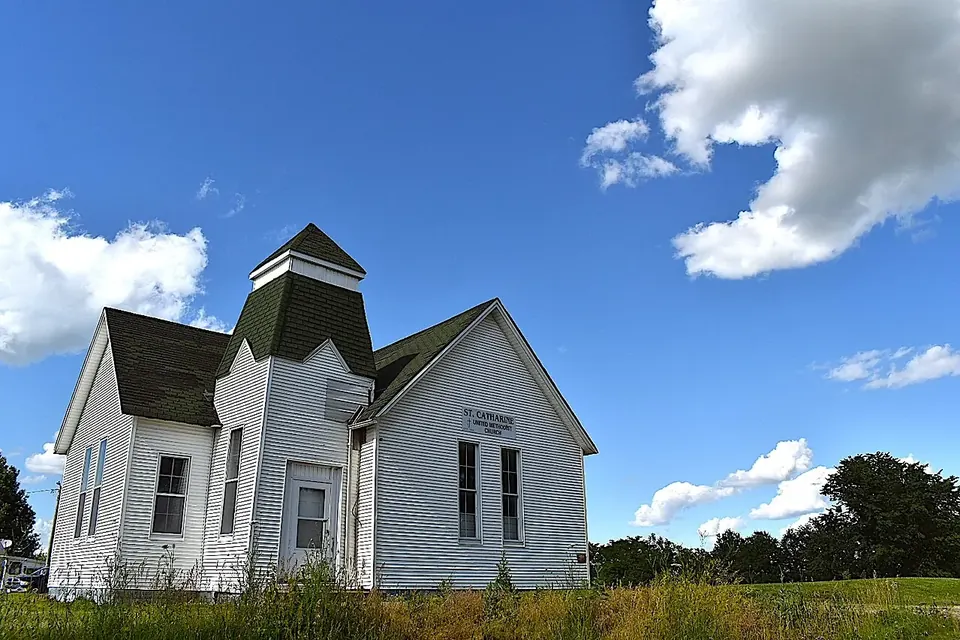
The five practices framework was born in a United Methodist setting, and the denomination has lived through its hardest decade in recent memory: a wave of congregations leaving between 2019 and 2023, then a General Conference in 2024 that changed church law on sexuality. What does survey data say about the people who still call themselves United Methodists? We read Pew Research Center's three Religious Landscape Studies (2007, 2014 and 2023-24) practice by practice, and kept only the comparisons that Pew says are sound.
Key figures
- 3% of U.S. adults identified as United Methodists in 2023-24, according to Pew's denomination profile (margin of error for the group: ±3.9 points).
- 48% of them pray at least daily, down from 62% in 2014 and 59% in 2007.
- 47% are 65 or older, up from 32% in 2014 and 26% in 2007; only 6% are under 30.
- 27% say they attend services at least weekly in 2023-24, a figure Pew says cannot be compared with earlier surveys.
- 1,425,352 people attended U.S. United Methodist worship in person in an average week of 2022, against 5,424,043 members on the rolls (denominational figures).
The question, and why it matters now
Membership totals are the figure most often quoted about the denomination, and the least informative. The church's own news service has explained why membership numbers are hard to trust: rolls are cleaned irregularly, and one finance official quoted there considers attendance "a more reliable metric of the activity of a church." Survey data adds something rolls cannot: what members actually do and believe. Pew's study is the largest such source, with 1,318 United Methodist respondents in 2023-24, 1,637 in 2014 and 2,239 in 2007.
The timing matters too. In May 2024 delegates voted 692-51 to remove the ban on gay clergy, a vote that, as CBS News reported from the Associated Press, came after "the departure of one-quarter of the U.S. churches within the UMC." The 2023-24 survey was fielded between July 2023 and March 2024, at the end of that exodus and just before the vote: it is the first portrait of the denomination that remained.
A warning before reading any trend
The 2007 and 2014 studies were telephone surveys. The 2023-24 study was mostly answered online or on paper, and Pew ran a separate telephone "bridge study" to test which questions changed with the mode alone. Its appendix on comparing results sorts questions into three groups: green (safe to compare), yellow (compare with caution) and red (do not compare). Religious attendance and scripture reading are red: people report going to church more often when talking to an interviewer. That is why the weekly attendance figure for United Methodists, 27% in 2023-24 against 44% in 2014, must not be read as a collapse. Pew had already shown in a 2021 analysis of survey modes how much the way a question is asked shapes the answer.
Practice by practice
Passionate worship: one snapshot, no trend
In 2023-24, 27% of United Methodists say they attend at least weekly, 12% once or twice a month, 24% a few times a year and 36% seldom or never. Because the question is red, the honest reading is a snapshot: a little over a quarter of those who claim the name are in a pew most weeks. The denomination's own count points the same way. The church's statistical summary gives an average weekly attendance of 1,425,352 in person for the U.S. in 2022, about 26% of the 5,424,043 members on the rolls, plus 1,715,890 online. Two very different methods, one survey and one headcount, land within a point of each other. For more on what worship asks of a congregation, see our page on passionate worship.
Intentional faith development: prayer and small groups have thinned
Daily prayer is a green question, so this decline is real: 59% of United Methodists prayed at least daily in 2007, 62% in 2014, 48% in 2023-24. Taking part in a prayer or scripture-study group at least weekly fell from 25% to 11% since 2014. That question is yellow: Pew concludes that weekly participation in such groups has declined across the population, "although not necessarily by the full amount of the difference seen in results." The direction is clear even if the size is not. Weekly scripture reading (20% in 2023-24) is red and has no usable trend. Small groups are the backbone of intentional faith development; these numbers suggest that is where congregations have most to rebuild.
Belief: steady at the core, less certain at the edge
Nearly all United Methodists still believe in God or a universal spirit, but the share who are absolutely certain fell from 78% in 2007 to 71% in 2014 and 64% in 2023-24, a comparison Pew rates as safe. The share saying religion is "very important" in their lives dropped from 61% to 41%, but Pew flags that question as yellow: it scores lower in the new survey even against Pew's own other polls, partly because of where it sits in the questionnaire.
Radical hospitality: an older church, a changed outlook
The age profile is the starkest result. Almost half of United Methodists are now 65 or older (47%), up from a quarter in 2007; 6% are aged 18 to 29, and only 16% have children under 18 at home, against 28% in 2007. Meanwhile the share saying homosexuality should be accepted by society rose from 51% to 60% to 68%, the part of that question Pew says can be compared. Departures of mostly conservative congregations probably explain part of this shift: the survey describes who remained, not how individuals changed their minds. For a congregation, the practical question is the one at the heart of radical hospitality: who is missing from the room, and what would it take to welcome them?
The full table
| Measure (United Methodist adults) | 2007 | 2014 | 2023-24 | Pew comparability |
|---|---|---|---|---|
| Pray at least daily | 59% | 62% | 48% | green |
| Believe in God, absolutely certain | 78% | 71% | 64% | yellow (this answer comparable) |
| Religion very important | 59% | 61% | 41% | yellow |
| Prayer or scripture group at least weekly | 19% | 25% | 11% | yellow |
| Homosexuality should be accepted | 51% | 60% | 68% | yellow (this answer comparable) |
| Aged 65 or older | 26% | 32% | 47% | demographic |
| Aged 18 to 29 | 10% | 9% | 6% | demographic |
| Attend services at least weekly | 43% | 44% | 27% | red: do not compare |
| Read scripture at least weekly | 33% | 39% | 20% | red: do not compare |
What this means for a church council
- Count what you can trust. Your own attendance and small-group numbers, kept the same way year after year, say more than membership rolls. Our essay on fruitfulness and numbers explains why the count is a tool, not a verdict.
- Do not quote the attendance "collapse". The drop from 44% to 27% mixes real change with a change of survey method; Pew itself refuses the comparison.
- Look at small groups first. Daily prayer and weekly group participation are the clearest, most comparable declines, and the most within a congregation's reach.
- Plan for an older membership. With almost half of members over 65, hospitality to younger adults and families is no longer optional.
The wider context is less gloomy than these figures suggest: Pew's headline finding is that the decline of Christianity in the U.S. has slowed and may have levelled off, with 62% of adults identifying as Christian, roughly stable since 2019.
Methodology
Figures for United Methodists come from the tables of Pew Research Center's denomination profile (Religious Landscape Study fielded 17 July 2023 to 4 March 2024; earlier studies in 2007 and 2014), read on 21 November 2026. Comparability labels follow Pew's Appendix A; where only one answer of a yellow question is comparable, we show that answer only. "United Methodist" means people who identify with the denomination in the survey, not members on church rolls. Denominational figures (members, churches, attendance) are the 2022 U.S. jurisdictional figures published by United Methodist Communications from reports to the General Commission on Finance and Administration; the same page gives a current worldwide membership of about 11,299,000 from a November 2025 report. We do not republish Pew's data files; the table above quotes the published percentages. The chart is free to reuse with a link to this page. Updated 21 November 2026.
Sources
- Pew Research Center, Religious Landscape Study: members of the United Methodist Church; Appendix A, comparing results across studies; "Decline of Christianity in the U.S. has slowed, may have leveled off" (26 February 2025); measuring religion across survey modes (2021).
- United Methodist Communications, United Methodists at a glance; UM News, how accurate are church membership numbers; GCFA data services.
- CBS News / Associated Press, General Conference vote, 1 May 2024.
 Notebook
Fruitfulness is more than numbers
Counting matters, but counts are not the fruit. How to measure without being ruled by the measure.
 The five practices
Intentional faith development
Small groups, classes and mentoring: how a church helps faith grow beyond Sunday.
 The five practices
Passionate worship
Worship that is alive and prepared, whether it uses an organ, a band or both.